By NAMI Southwest Washington
March is recognized as Self-Harm Awareness Month, a time to bring compassion, education, and understanding to a behavior that is often misunderstood. Self-harm is rarely about wanting to die. More often, it is about trying to cope with emotional pain that feels too overwhelming to carry alone. For many people, self-injury becomes a way of expressing feelings they don’t yet have words for.
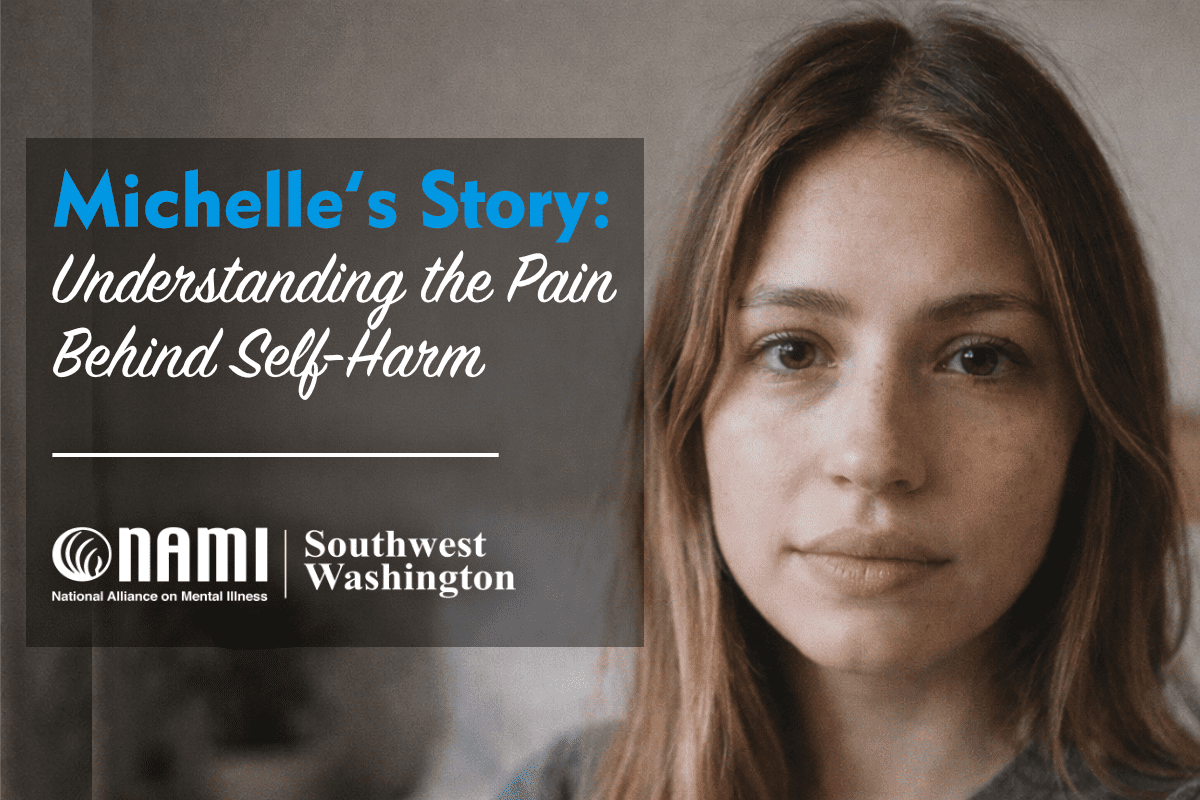
Michelle knows this experience all too well.
Michell’s Story:
Today, Michelle is in her early thirties. She has a career she enjoys, strong friendships, and a life that feels stable and meaningful. But when she looks back at her teenage years, she remembers a very different reality.
Growing up, Michelle was the kind of student teachers praised. She was quiet, responsible, and rarely caused problems. From the outside, her life looked perfectly normal. Inside, however, she was struggling with feelings she didn’t understand and didn’t believe she was allowed to talk about.
Michelle grew up in a household where emotions were rarely discussed. When conflict happened, it was usually ignored or brushed aside. As a result, she learned early on to keep her feelings to herself. By the time she reached high school, those bottled-up emotions had grown into something much heavier — a constant sense of pressure, sadness, and anxiety she couldn’t explain.
At school she worked hard to be the “good kid.” At home she tried not to create problems. But the more she pushed her emotions down, the more intense they became.
Michelle remembers the first time she harmed herself. She describes it as a moment when the emotional pain felt so overwhelming that she needed some kind of release. The physical pain briefly interrupted the storm inside her mind. For a moment, everything felt quieter.
That moment quickly turned into a pattern. For several years, self-harm became Michelle’s private coping mechanism. She carefully hid the marks, avoided conversations about her feelings, and convinced herself that no one would understand anyway. On the outside she continued to succeed in school and maintain friendships. Inside she felt increasingly isolated.
What made things more complicated was that Michelle didn’t fully understand why she was doing it. She knew it wasn’t healthy, but she also didn’t know what else to do with the emotions she carried.
The turning point came during her first year of college. Michelle had moved away from home and was experiencing the stress of new responsibilities, academic pressure, and loneliness. One evening, after another difficult day, she found herself repeating the same harmful pattern she had relied on for years.
But this time something felt different. Instead of feeling relief, she felt a sudden wave of exhaustion and confusion. She began asking herself a question she had never fully explored before:
Why am I doing this?
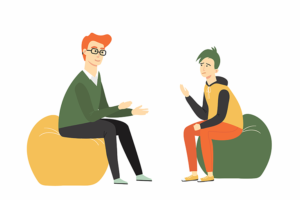
That question opened the door to something new. Michelle eventually began speaking with a counselor, something she had avoided for years because she worried it would mean admitting she was “broken.” Instead, those conversations helped her understand that her behavior wasn’t about weakness — it was about coping with emotions she had never been taught how to process.
She began to see that self-harm had been her way of managing intense feelings of shame, pressure, and loneliness. It had been a way to release emotional pain when she didn’t feel safe expressing it in other ways. Understanding the why behind her behavior didn’t fix everything overnight. Recovery wasn’t a straight path. But recognizing the root of her pain became the first and most important step toward healing.
With time, Michelle learned healthier ways to cope with overwhelming emotions. She practiced identifying her feelings instead of pushing them away. She began reaching out to trusted friends when things felt heavy instead of isolating herself. Slowly, the urge to harm herself lost its grip.
oday, Michelle shares her story because she knows how many young people still carry that same silent pain.
She often says the hardest part of recovery wasn’t stopping the behavior — it was believing she deserved help in the first place.
Self-Harm Awareness Month exists to remind people that compassion and understanding can change lives. When we talk openly about mental health and emotional struggles, we help create a world where fewer people feel they have to suffer alone.
Michelle’s story is a reminder that self-harm does not define a person. It is a sign that someone is hurting and searching for a way to cope. With understanding, support, and patience, healing is possible.
And sometimes, the first step toward recovery begins with a simple but powerful question:
What pain am I really trying to express?